In honor of the Nonprofit Technical Assistance Grant Program (NTAG)’s 40th Anniversary, we are revisiting some of the program’s most prominent projects. From its inception as the City Ventures Fund (CVF) to its current name, NTAG, the program has invested $1.7 million in more than 80 buildings in low- and moderate-income neighborhoods across the city.
NTAG seeks to empower nonprofit property owners by supporting them with the financial and technical assistance they need to maintain and restore their buildings. Many nonprofit organizations own and/or are stewards of hundreds of properties that provide essential neighborhood services. The program creates an important link between preservation and community development in New York City and allows the Conservancy to partner with nonprofit organizations to increase the impact of its work.
64 Havemeyer Street, Brooklyn
64 Havemeyer Street was the first project undertaken by CVF. With its peaked roofline, corner turret, and tall, slim windows, this High-Victorian Gothic building comprises an imposing and distinctive component of a religious campus built by the Roman Catholic Church. The four-story structure made of red brick, sandstone, and terra cotta served as a convent, set alongside a school, rectory, and the Church of the Annunciation of the Blessed Virgin Mary.
After buying the former convent from New York City in 1989, a group of young homeowners created the Convent Housing Development Fund and, at first, resolved to convert the building themselves. When that proved overwhelming, they were referred to the NYLC. We initially provided $85,000 in loans and grants to assist in creating an 11-unit limited-equity co-op and to help find a preservation architect for the project. We later assisted the co-op in obtaining a $776,210 grant from the State Housing Trust Fund and provided a $185,000 low-interest loan.

218 Gates Avenue, Brooklyn
At the onset of CVF, the Conservancy found a natural partner in New York’s nonprofit community development corporations. Following the creation in 1967 of the nation’s first, the Bedford Stuyvesant Restoration Corporation, dozens more such organizations had sprung up in distressed neighborhoods throughout the City. Deteriorating and abandoned housing abounded in such areas, and finding ways to rehabilitate such buildings while keeping them affordable became a major aim.
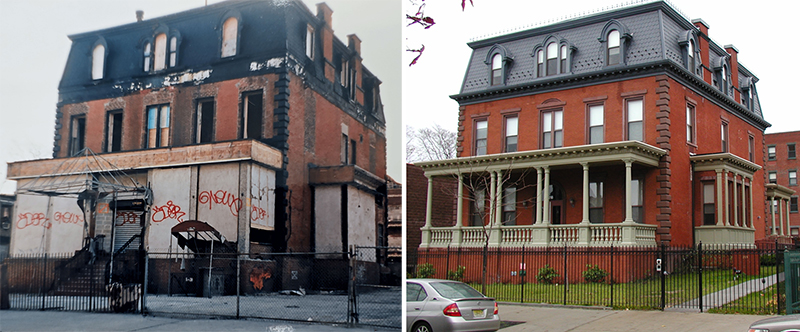
The Conservancy worked on multiple projects with the Pratt Area Community Council, now known as IMPACCT. 218 Gates Avenue in Bedford-Stuyvesant is a Second Empire-style brick mansion, originally built for lace merchant John Gibb in the 1860s. A $60,000 CVF grant funded the restoration of an elaborate slate mansard and dormered roof, capped by decorative cast-iron cresting. The Pratt Area Community Council transformed the building into 71 units for low-income people with HIV and AIDS, with dining facilities, counseling offices, and recreation space.
345 Edgecomb Avenue & 583 Riverside Drive, Manhattan
In the early 2000’s, the Broadway Housing Corporation was the recipient of CVF grants for two Harlem housing preservation projects: 345 Edgecomb Avenue and 583 Riverside Drive, both of which still provide low-income housing today. A new clay tile roof was installed at 345 Edgecomb Avenue, funded by a $25,000 grant, and a new cornice was put up at 583 Riverside Drive, funded by a $60,000 grant.
On the completed project at 345 Edgecomb Avenue:
“It makes the whole block shine. But we never could have done it without the Conservancy. The Conservancy was one of the first organizations in, and it was that commitment that leveraged enough support so that we wouldn’t have to do the work in stages. The Conservancy’s help with selecting a contractor who had experience in preservation made an enormous difference.” – Ellen Baxter, president of Broadway Housing


Weeksville Heritage Center, Brooklyn
In 2008, the City Ventures Fund expanded to include Community Facilities, in addition to affordable housing. The Weeksville Heritage Center was one of the first grant awardees under this new criterion.
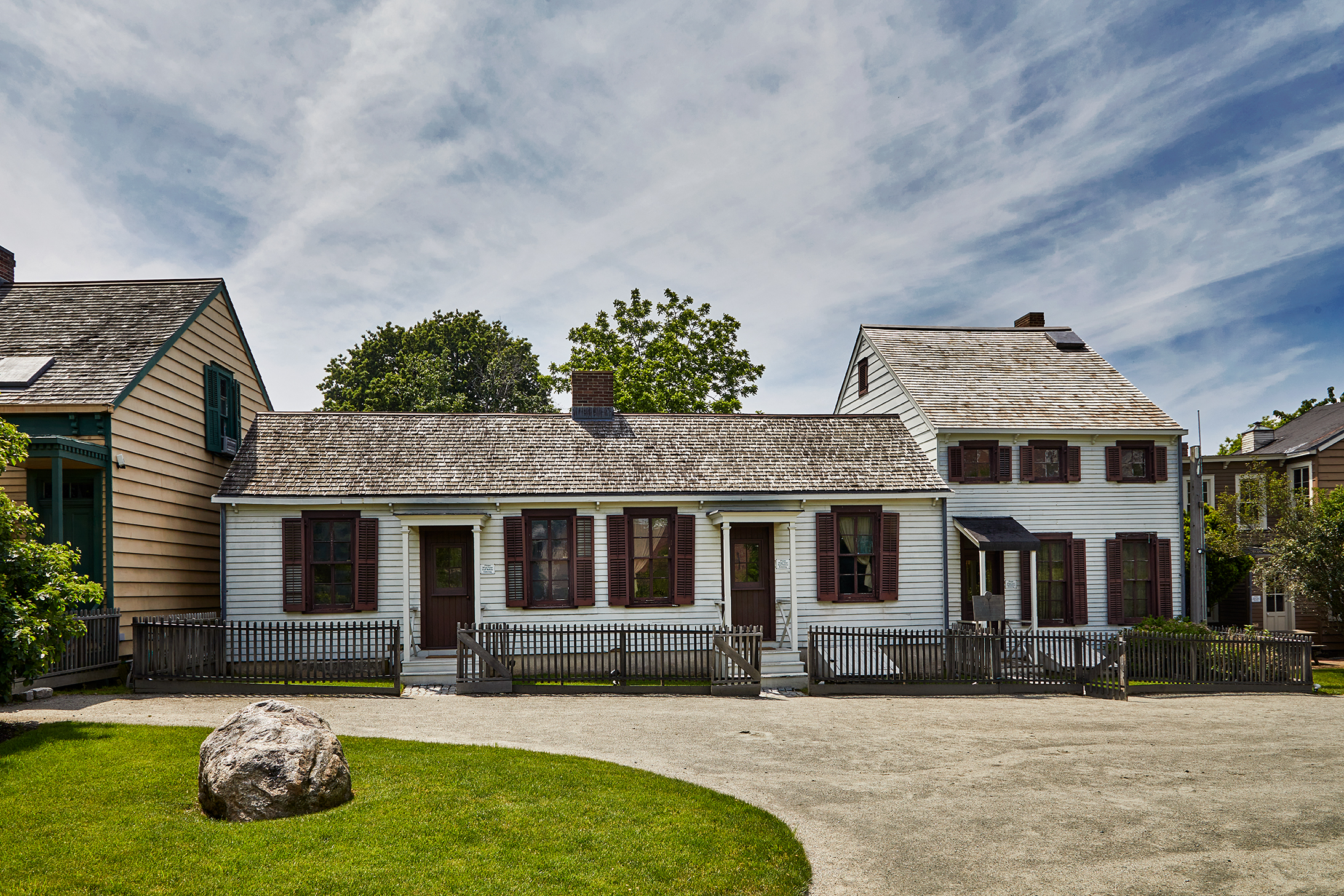
Founded before the Civil War, Weeksville was one of the country’s first free Black communities and one of the few of its era still extant. Members of the community, who had played an important role in the abolitionist movement, constructed numerous one- and two-story wooden houses. They also built churches, a school, an orphanage, a home for the elderly, and a structure housing one of the nation’s first African American newspapers, the Freedman’s Torchlight. All but subsumed into modern-day Brooklyn by the 1960s, the buildings were rediscovered, leading to their restoration and preservation. In addition to offering historical, educational, and cultural programming, the Weeksville Heritage Center serves as a community hub to improve access to affordable, healthy food and lifestyle options through in-person workshops, a seasonal Green Market, and an annual Harvest Festival.
The Conservancy was an early proponent of interpreting the community’s remaining houses and opening them to the public, and we have continued a strong relationship with Weeksville through today. Combining resources from multiple of the Conservancy’s nonprofit grant programs, we provided $11,353 for a conditions survey and $27,825 to complete restoration (2010-2019). Recently, we gave more than $57,000 to replace a roof, restore deteriorated wood features, fix an access ramp, and renovate the Summer House.
Rossville AME Church- Sandy Ground Cemetery, Staten Island
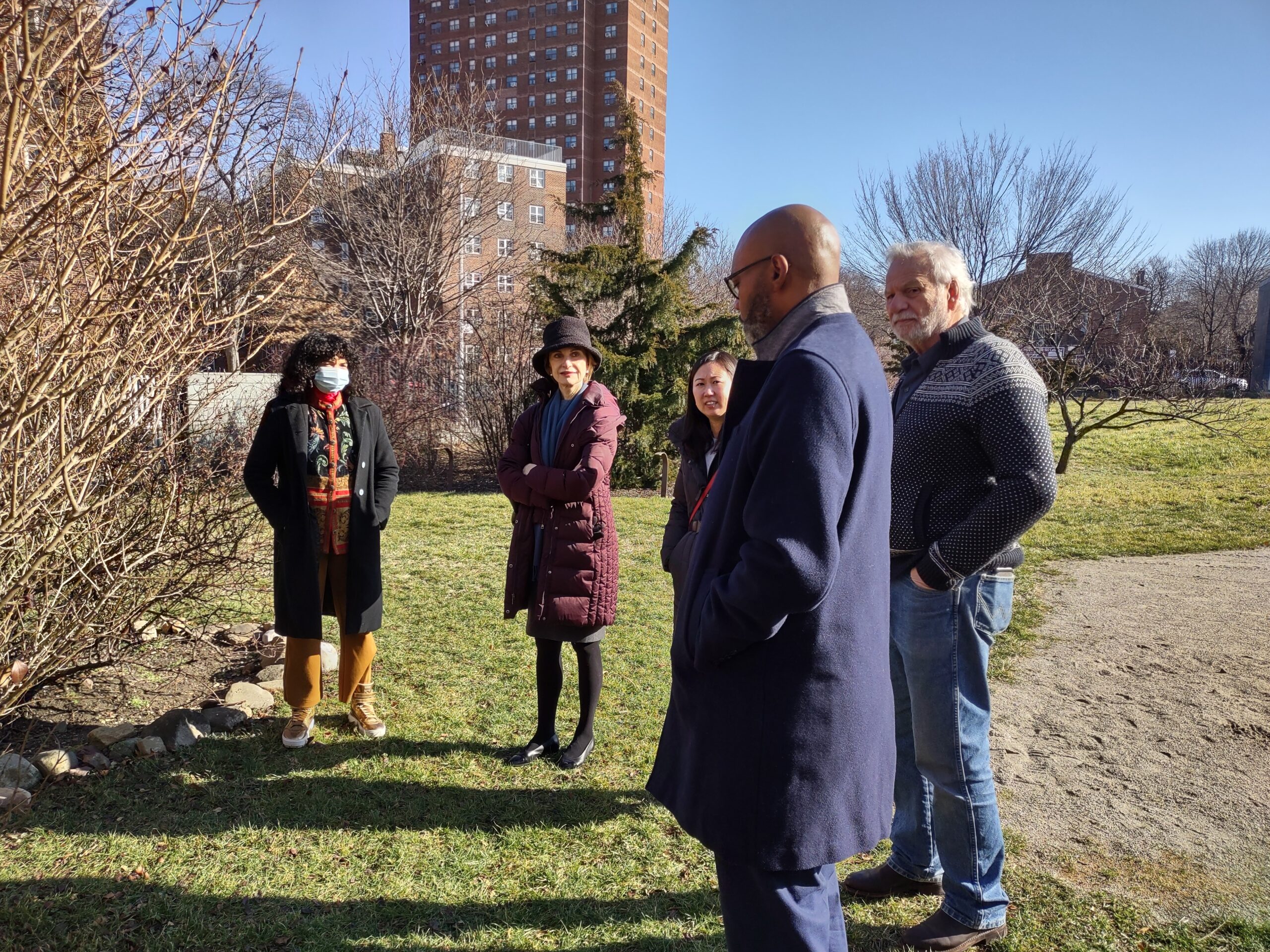
In 2014, the CVF took on a unique project, as it assisted the Rossville A.M.E. Zion Church with its landmark properties in the “Sandy Ground” section of Staten Island. Once a free black community of people working in the oyster trade, Sandy Ground thrived from the 1830s to about 1900, when the polluted waters of New York ended the oyster business. The Church wished to conserve what little remains of this era to foster recognition of Sandy Ground as a heritage tourism destination.
The Conservancy supported the preparation of a Cultural Landscape Report for the cemetery with a grant of $23,750. The purpose of the Report was to help the Church to maintain and restore the cemetery. A major surprise of the investigation was locating more than 500 unmarked graves (typical of earlier African burial customs) via a ground-penetrating radar survey of the one-acre site.
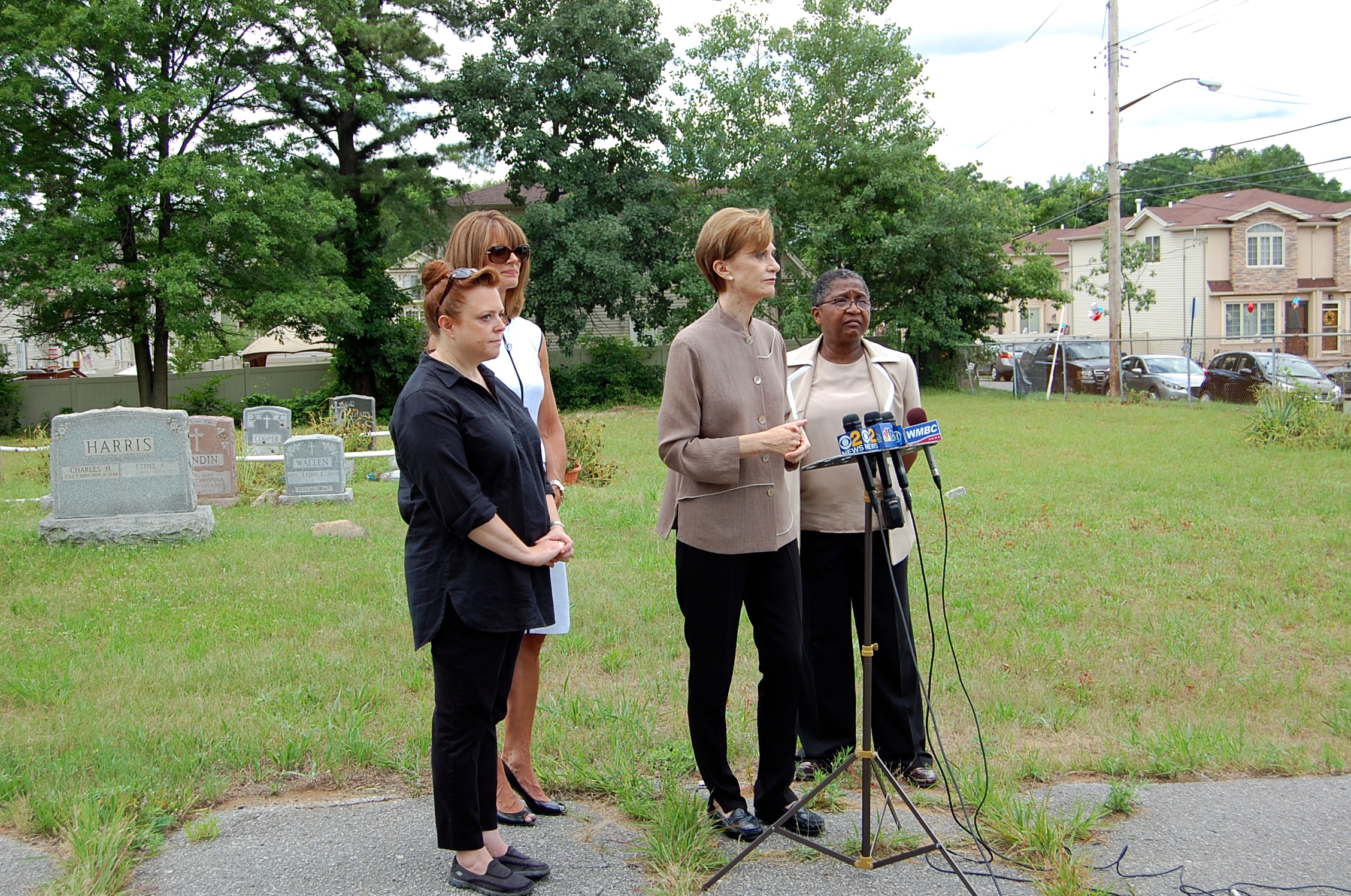
Rossville A.M.E. Zion Church also owns two landmark-designated cottages across the street from the church building at 565 and 569 Bloomingdale Road. The small frame houses were constructed between 1887 and 1898 and are some of the few surviving buildings in this historic community. As a first step, the Conservancy provided a grant of $2,500 to prepare a conditions survey, along with recommendations for restoration work and cost estimates.

Henry Street Settlement, Manhattan
Henry Street Settlement was established by progressive reformer and nurse Lillian Wald and helps New Yorkers through social services, the arts, and health care. Offering more than 50 programs to people of all ages, Henry Street serves over 50,000 individuals annually. Programs include Meals on Wheels, job readiness, supportive housing, and theater performances.
The CVF allowed for the restoration of the original 1830’s ironwork fence on the building’s exterior, aiding in the preservation of the building’s historic character. To preserve the heavily deteriorated, genuine cast iron and wrought iron elements of the fence, a $30,000 grant was given, requiring additional involvement of the Landmarks Preservation Commission.


This project included the removal, restoration, and reinstallation of the panel fencing, stoop railings, stair railings, post caps, and newel posts; missing and damaged decorative elements will be replicated where necessary. The ironwork was sprayed with a galvanized coating to prevent rusting, then finished in a semi-gloss urethane black paint to ensure that the ironwork will maintain its look and stability for decades to come.
Huntington Free Library, The Bronx
In recognition of its expanded purview and with the support of the Altman Foundation and the Hearst Foundation, the program took on its new name in 2021: the Nonprofit Technical Assistance Grant Program (NTAG). The program and its partners continue to bring the benefits of preservation to neighborhoods of every economic level throughout the City.
One of the first building projects funded under the reignited program was the Huntington Free Library and Reading Room. The Huntington Free Library was founded in 1892 as the first free public library to serve the Westchester Square area. The building was designed by Frederick Clarke Withers, architect of the Jefferson Market Library in Greenwich Village, and is one of his few surviving works in New York City. An individual landmark, the library offers public access to its research collections as well as educational lectures and community events in partnership with local businesses. The NTAG grant of $10,000 in 2022 covered architectural services for the restoration of the original slate roof, as well as its historic finials and cresting.
“We are extraordinarily grateful for the incredible generosity of the Landmarks Conservancy in supporting the Huntington Free Library and Reading Room’s restoration of its historic roof. With the support, we were able to hire an architect and commence the initial process of the restoration. Thank you for allowing this important project to move forward and thus preserving our historic institution for future generations to come.” – Angel Hernandez, President, The Huntington Free Library & Reading Room


Coney Island Museum, Brooklyn
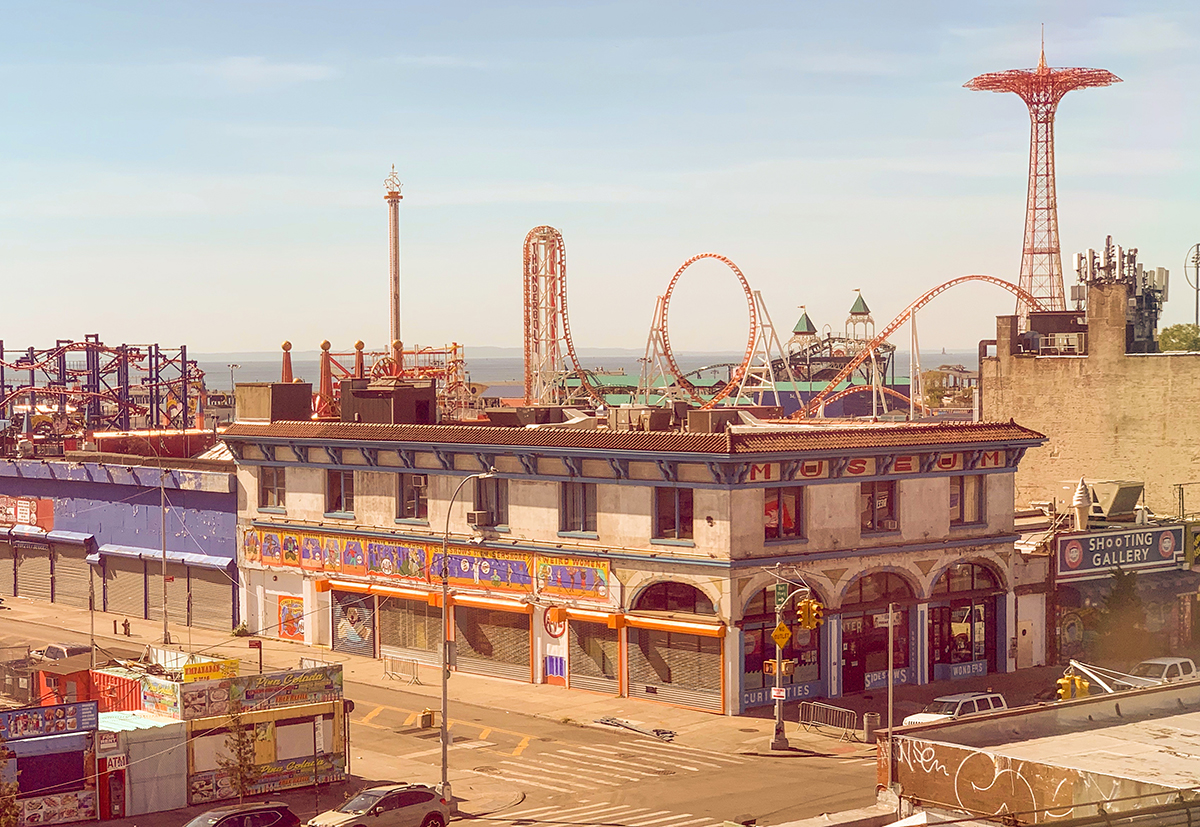
The Coney Island Museum, a multi-arts center in the heart of the neighborhood, celebrates American popular culture through themed exhibitions and performances that celebrate the unique history of Coney Island. In-house programming draws roughly 28,000 annually, and the organization seeks to preserve the traditions of vaudeville, dime museums, circus sideshow, and burlesque. It does so in conjunction with Coney Island USA out of the historic building at 1208 Surf Avenue, constructed in 1917 by John C. Westervelt. Originally built as a Childs Restaurant, this building housed the luncheonette chain famous for its affordable food and friendly service for working-class New Yorkers escaping the city for a beach day. The building was designed in the Spanish Revival style with a red tile roof, grand arches, and a white facade, and is a rare survivor representing the history of Coney Island.
Given its significance as the oldest landmarked building in Coney Island, NTAG provided a grant of $5,850 in 2022 to the Coney Island Museum to cover a conditions assessment report. The report helped to establish the scope of work needed for restoration and provided recommendations for prioritizing repairs.